Pain in the lower back does not automatically mean a slipped disc. The pattern becomes more concerning when pain travels into one leg or is joined by tingling, numbness or weakness, and certain bladder, bowel or neurological changes require emergency care. By the end, you will know which symptoms to monitor, when to seek help, and what a proper assessment involves.
Key takeaways
- Leg pain below the knee, tingling, numbness or weakness points to nerve irritation.
- Seek urgent care for bladder or bowel changes, saddle numbness or worsening leg weakness.
- Doctors check strength, reflexes, sensation and walking before ordering an MRI.
- Treatment ranges from activity changes and physiotherapy to injections or surgery.
Which symptoms make a slipped disc more likely?
A slipped disc becomes more likely when low-back pain is joined by nerve-related symptoms in one leg: pain travels from the buttock down the thigh or calf, often below the knee, with tingling, numbness, burning, or weakness.
This pattern suggests irritation of a lumbar nerve root by a herniated or prolapsed disc rather than ordinary muscle soreness.
| Pattern | What it suggests |
|---|---|
| Pain only in the lower back | Not specific for a slipped disc; muscle, facet-joint, sacroiliac and other problems can feel similar |
| One-sided pain from the back or buttock into the leg | Sciatica, which makes nerve irritation more likely |
| Pain below the knee with tingling or numbness | A stronger slipped disc sign because the symptoms follow a nerve pathway |
| Weakness in the leg or foot | Reduced nerve function; notice difficulty lifting the foot, standing on tiptoes, or pushing off while walking |
A disc problem can cause little back pain when nerve irritation dominates. Coughing, sneezing, straining, or prolonged sitting can intensify the leg pain by increasing pressure around the irritated nerve.
These slip disc signs raise suspicion but do not confirm the cause. A physical examination checks sensation, reflexes, walking, and muscle strength, because scans can show disc bulges that are not causing symptoms. Pain confined to the back without leg pain, altered sensation, or weakness is less characteristic of a herniated disc.
Which back-pain symptoms need urgent or prompt medical attention?
Seek emergency assessment now for new urinary retention, loss of bladder or bowel control, numbness around the genitals or anus, or severe or worsening weakness in both legs. These symptoms can indicate cauda equina syndrome or major nerve compression; do not wait for a routine slip disc consultation in Pimpri Chinchwad.
- Fever after a recent serious infection, significant trauma, unexplained weight loss, a history of cancer, or persistent night pain needs prompt medical evaluation.
- Arrange a routine review if back or leg pain persists, keeps returning, disrupts sleep or work, or does not improve with sensible self-care.
- Book an examination for unusual symptoms, including pain with little back pain, altered sensation that spreads, or weakness in one foot or leg.
| Situation | Why it matters | What to do |
|---|---|---|
| Emergency nerve symptoms | Possible cauda equina syndrome or major compression | Go to an emergency department immediately |
| Fever, cancer history, trauma, weight loss or night pain | Infection, fracture or cancer can mimic disc pain | Seek prompt medical assessment |
| Persistent sciatica or weakness in one leg | A nerve may remain irritated or compressed | Arrange a medical review soon |
| Pain limited to the lower back | Muscle, facet-joint, sacroiliac or non-spinal causes are also possible | Book a routine examination if it persists |
Slip disc signs such as one-sided leg pain, tingling, numbness or weakness cannot confirm the cause without a nerve examination.
What conditions can mimic a slipped disc, and what does the first examination check?
Back pain alone does not prove a slipped disc. The clinician compares the pain pattern with examination findings and checks whether numbness or weakness follows a particular nerve root.
| Cause | Clues that shift suspicion |
|---|---|
| Muscle strain | Pain stays near the lower back, with tenderness and pain during movement but no numbness or weakness. |
| Facet-joint or sacroiliac pain | Pain remains local or spreads into the buttock, without a consistent strip of altered sensation. |
| Hip disorder | Groin pain, reduced hip movement, limping or difficulty putting on socks points away from the spine. |
| Kidney problem | Flank pain, fever, burning urine, blood in urine, nausea or urinary symptoms need a different assessment. |
| Infection, cancer or fracture | Fever, recent serious infection, unexplained weight loss, cancer history, major trauma or persistent night pain require prompt medical evaluation. |
During the examination, the clinician checks:
- Walking pattern, posture and balance.
- Spinal movement and areas of tenderness.
- Muscle power in the hip, knee, ankle and toes.
- Sensation and reflexes on both legs.
- Nerve-tension signs, including a straight-leg raise when appropriate.
- Symptom duration, leg distribution, bladder or bowel changes, medicines, and work or activity demands.
Weakness or numbness in a matching nerve-root pattern supports disc-related nerve irritation; normal nerve findings make muscle, joint or hip pain more likely. If you search for a spine problem doctor near me, choose a clinician who performs this assessment and explains the next step rather than advertising surgery alone.
When is an MRI needed for suspected slip disc?
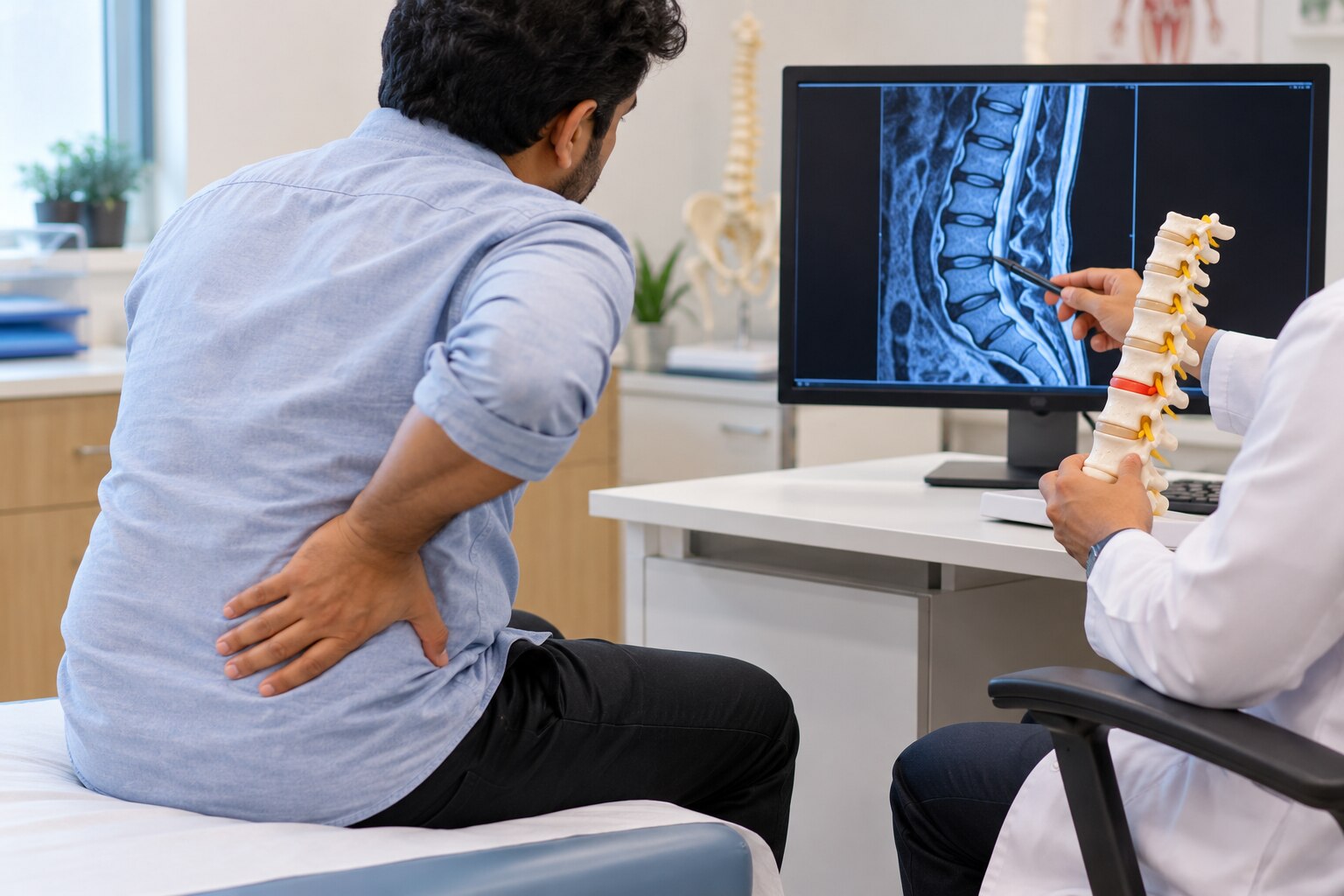
An X-ray can show broken bones, spinal alignment, narrowing between vertebrae, arthritis and other bony changes. It cannot show a herniated disc or confirm that a nerve root is compressed, so a normal X-ray does not rule out a slip disc.
MRI is the preferred scan when imaging is clinically indicated because it shows the discs, spinal canal, nerve roots and soft tissues.
It is appropriate when severe or worsening weakness appears, emergency warning signs raise concern about major nerve compression, symptoms persist despite an appropriate period of treatment, or the result will affect an injection or operation.
Routine MRI at the first visit is usually unnecessary when symptoms are recent, the neurological examination is reassuring and no serious cause is suspected. A scan can expose harmless findings, trigger anxiety and lead to procedures that will not improve the actual pain.
A report alone does not prove that the disc is causing your symptoms. Disc bulges, degeneration and mild narrowing also occur in people without pain. The clinician must match the MRI level and side with your pain pattern, muscle power, sensation, reflexes, walking and nerve-tension tests.
During a slip disc consultation in Pimpri Chinchwad, ask what finding explains your symptoms and what treatment decision the scan will change. Seek emergency care for new urinary retention, bladder or bowel loss, saddle numbness, or severe weakness in both legs.
What treatment can follow a confirmed diagnosis?
A confirmed disc herniation does not automatically require surgery. Match the treatment to your pain pattern, nerve examination, symptom duration, work demands and whether the MRI finding matches the affected nerve.
| Option | What it means | When it applies |
|---|---|---|
| Non-surgical care | Continue suitable activity, use clinician-advised pain relief, and follow physiotherapy with gradual strengthening | First choice when weakness is absent or stable and symptoms are manageable |
| Epidural injection | Local anaesthetic with steroid is placed near the irritated nerve; it reduces inflammation but does not repair the disc | Selected cases of acute, severe sciatica, not ordinary lower-back pain without leg symptoms |
| Decompression surgery | A procedure such as microdiscectomy removes disc material pressing on a nerve | Progressive weakness, emergency nerve compression, or persistent disabling leg pain despite appropriate non-surgical care |
When searching “spine problem doctor near me” in Pimpri-Chinchwad, choose an orthopaedic spine specialist, neurosurgeon or qualified musculoskeletal clinician who will examine you rather than advertise surgery alone. Ask whether the consultation covers:
- Walking, posture, spinal movement, muscle power, sensation, reflexes and straight-leg raise
- Pain duration, leg distribution, medicines, work demands and activity limits
- The reason for an MRI or injection, expected benefit, risks and alternatives
Whether you consult Anand Orthopaedic Hospital or another provider, seek emergency care for new bladder retention, bladder or bowel loss, saddle numbness, or rapidly worsening weakness in both legs. Compare clinicians by examination quality and explanation, not by the phrase “slip disc symptoms and treatment in Pimpri Chinchwad” alone.
Related product
Spine problem & slip disc treatment. Spine problem & slip disc treatment. Dr Niranjan Ganjewar is well qualified to offer surgical treatment for the whole spine extending from the neck to the lower lumbar spine which... View product → |
Frequently asked questions
Which symptoms make a slipped disc more likely?
Low-back pain with nerve symptoms in one leg makes a slipped disc more likely. Watch for pain travelling from the buttock below the knee, tingling, numbness, burning or weakness.
Which slip disc symptoms need urgent medical attention?
Seek urgent care for new bladder or bowel control problems, numbness around the inner thighs or genitals, or rapidly worsening leg weakness. Prompt medical review is also important when pain, numbness or weakness is steadily worsening.
What conditions can mimic a slipped disc?
Muscle strain, spinal stenosis, facet-joint pain, sacroiliac-joint problems, hip disease and conditions such as infection or fracture can resemble a slipped disc. The first examination checks strength, reflexes, sensation, walking and pain patterns.
When is an MRI needed for suspected slip disc?
An MRI is most useful when serious warning signs exist, neurological problems are progressing, symptoms persist despite initial treatment, or a procedure is being considered. Doctors do not need an MRI for every episode of uncomplicated back pain.
What treatment can follow a confirmed slip disc diagnosis?
Treatment can include appropriate activity, pain relief, physiotherapy and exercises. Persistent nerve pain may lead to an injection discussion, while significant or progressive nerve compression can require surgical assessment.
Keywords