A construction accident can damage bone, blood vessels, nerves, muscle, skin and internal organs at the same time. You will learn which signs demand an ambulance, how a trauma team prioritises treatment, what staged surgery involves and how to assess a hospital or surgeon after the emergency is under control.
Key takeaways
- Treat open fractures, crush injuries and suspected compartment syndrome as emergencies.
- Ask whether scans checked blood vessels, nerves, muscles and hidden fractures.
- Expect temporary stabilisation before definitive reconstruction when swelling or contamination is severe.
- Discuss repeat operations, rehabilitation milestones and work restrictions before discharge.
Which construction injuries need emergency trauma surgery?
Emergency trauma surgery is needed for open fractures, crush injuries, multiple fractures, dislocations, major tendon or ligament damage, suspected compartment syndrome, and limb-threatening vascular injury. These injuries need emergency treatment, not a routine orthopaedic appointment.
| Injury or warning sign | Why it is dangerous | Action |
|---|---|---|
| Open fracture or exposed bone | Bacteria can enter deep tissue, while bone and muscle may be damaged | Emergency assessment; cover it |
| Crush injury or multiple fractures | Muscle death, internal bleeding and crush syndrome can develop | Call 112 immediately |
| Cold, pale hand or foot, absent pulse, numbness or inability to move | Blood flow or nerve function may be failing | Treat as a limb emergency |
| Escalating pain, tight swelling or pain on passive stretch | Compartment pressure can permanently damage muscle and nerves | Do not wait for swelling to settle |
| Uncontrolled bleeding, loss of consciousness or breathing difficulty | Airway, circulation or other life-threatening injuries may be involved | Call India’s emergency number 112 |
Searches for “severe injury surgery near me” should not replace emergency triage. Call 112 or local ambulance services, rather than travelling unassisted to an outpatient clinic.
- Do not move someone with a possible spine or pelvic injury.
- Apply firm, direct pressure to external bleeding.
- Cover an open fracture with a clean dressing and immobilise the limb.
- Never push protruding bone back into place or repeatedly explore the wound outside an operating theatre.
How the trauma team finds hidden damage before operating
A crushed limb can hide bleeding, organ injury, spinal trauma and muscle breakdown. A high-energy fall, machinery accident or crush injury is therefore assessed as a whole-body emergency, not as a broken limb alone.
1. The trauma team starts with a primary survey: airway, breathing, circulation, neurological status and exposure. This identifies blocked airways, breathing failure, shock, altered consciousness, hidden bleeding and injuries to the head, chest, abdomen or spine before limb surgery takes priority.
2. The team repeats neurovascular checks and records pulses, skin colour, temperature, sensation and movement. A cold, pale or numb limb, absent pulse or new weakness can indicate arterial damage requiring urgent treatment.
3. X-rays show fractures and alignment. CT defines complex bone and joint injuries, while CT angiography checks suspected arterial damage. Clinicians also assess wound depth, contamination and tendon or nerve involvement, review tetanus status and screen for head, chest, abdominal and spinal injuries.
4. A crush injury can cause rhabdomyolysis: damaged muscle releases myoglobin and potassium, leading to acute kidney injury, dangerously high potassium and cardiac arrhythmias. Treatment can include repeated blood tests, intravenous fluids, urine-output monitoring and electrolyte correction alongside orthopaedic care.
5. Normal pulses do not rule out compartment syndrome because small vessels can remain open while pressure destroys muscle and nerves. Worsening pain, pain out of proportion or pain during passive stretch requires immediate reassessment, not waiting for swelling to settle.
What emergency stabilisation and staged surgery involve
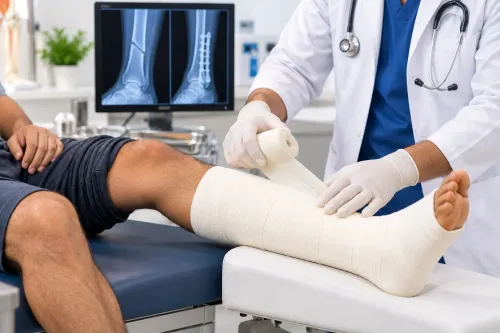
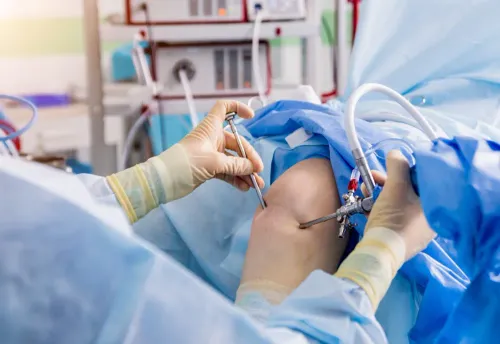
Damage-control treatment stabilises a dangerous injury; definitive reconstruction restores durable bone and soft-tissue function. An open fracture usually needs prompt intravenous antibiotics, tetanus review, urgent irrigation and debridement, removal of dead or contaminated tissue, a sterile dressing and repeated wound assessment.
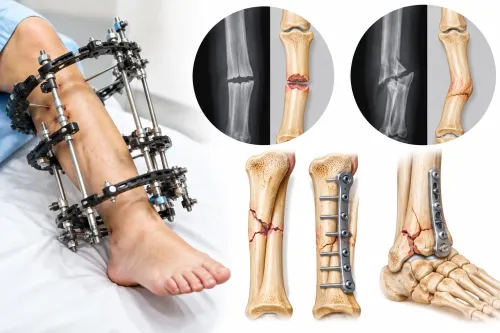
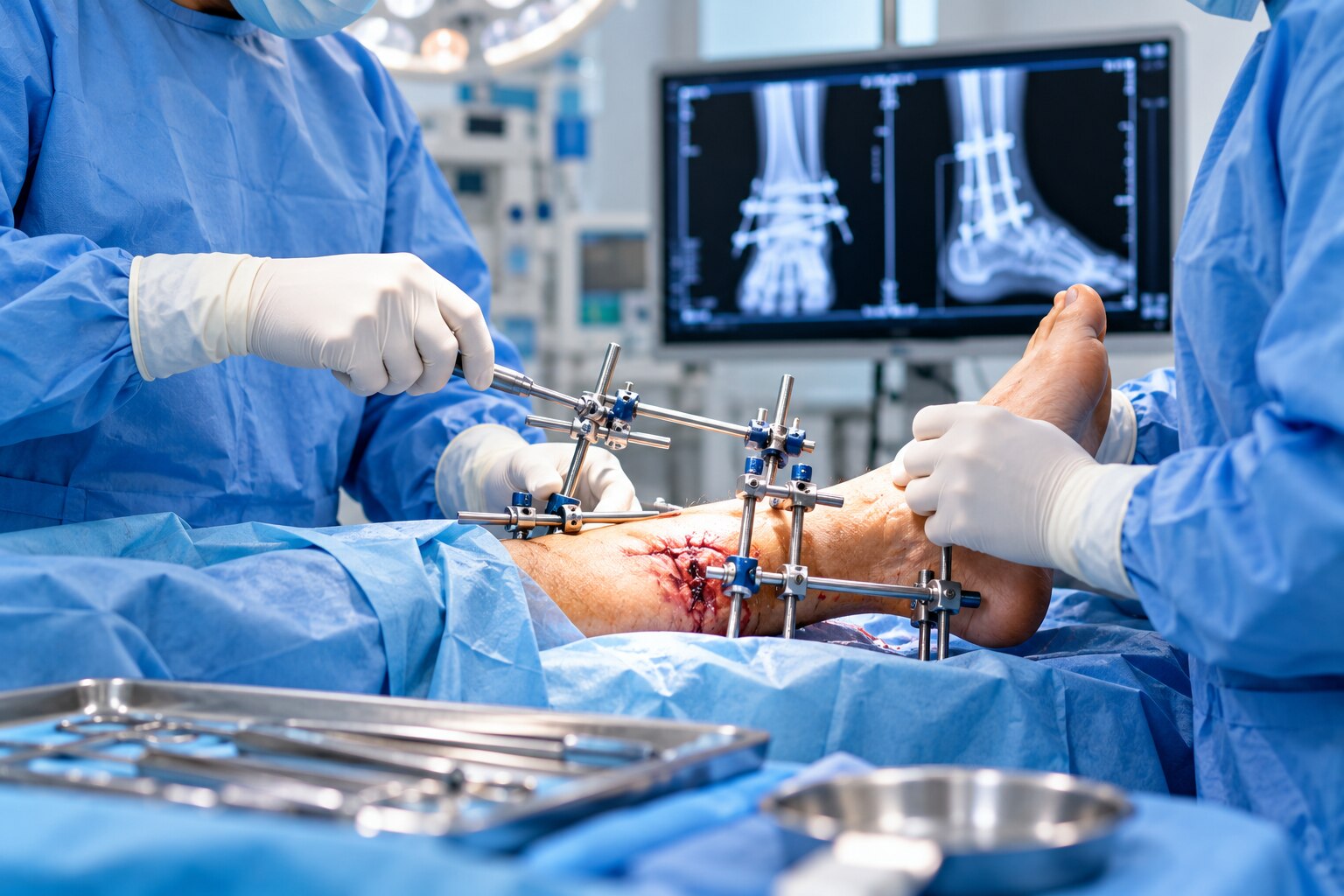
A temporary external fixator can hold the bones while swelling, contamination and skin damage become clearer.
The team chooses immediate fixation, staged surgery or non-operative care according to specific findings:
- Contamination and infection risk
- Swelling and skin viability
- Other injuries and medical stability
- Bone alignment, soft-tissue loss and expected healing
Later surgery may use plates, screws, nails or wires. Missing skin or muscle may require flap or graft coverage, sometimes after several wound operations. Complex trauma surgery for construction injuries in Pimpri Chinchwad therefore does not always mean one definitive operation.
Blood flow takes priority when a fracture is combined with arterial injury. Surgeons may place a temporary vascular shunt, apply external fixation and repair the artery urgently; delaying circulation can permanently destroy muscle and threaten the limb.
A mangled-limb decision is not based on the fracture alone. Salvage or amputation depends on warm-ischaemia time, viable muscle and skin, nerve and vessel damage, contamination, overall health, expected function and the rehabilitation burden. A multidisciplinary team weighs these factors rather than relying on a score or appearance alone.
How to choose a trauma hospital and surgical team in Pimpri Chinchwad
After emergency triage, choose a hospital that can coordinate the whole injury, not one that only advertises fracture treatment. A trauma surgeon in Pimpri Chinchwad should work within a team able to reassess the patient, obtain urgent imaging and operate with anaesthesia, blood products, infection-control procedures and intensive care support.
| Check | Why it matters | Ask |
|---|---|---|
| Emergency assessment and imaging | Hidden head, chest, abdominal, spinal or vascular injuries can change the operation | Is CT angiography available? |
| Orthopaedic trauma and anaesthesia | Fixation, debridement and staged reconstruction require coordinated operating-room care | Who leads the trauma plan? |
| Blood products and intensive care | Severe bleeding, crush injury or multiple fractures may need rapid support | Are blood products and ICU available on site? |
| Specialist access | Arterial, head, spinal and soft-tissue injuries need different expertise | Who manages vascular injury? |
| Repeat surgery and rehabilitation | Open fractures may need several operations, physiotherapy and staged coverage | Where are repeat operations performed? |
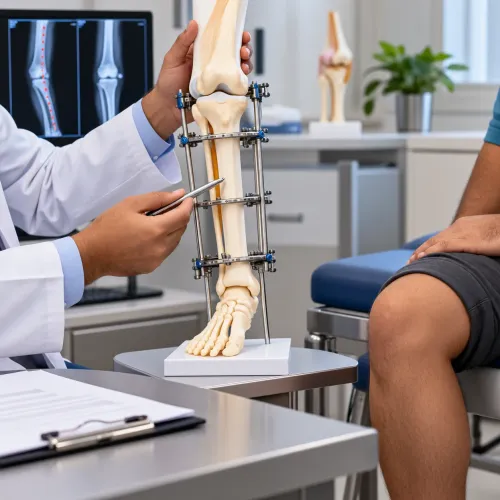
For a non-emergency consultation, verify the surgeon’s recognised orthopaedic or trauma qualification, experience with open fractures and staged reconstruction, and the person responsible for follow-up. Confirm that physiotherapy is available.
A construction accident orthopedic surgeon may perform fixation, debridement or reconstruction; vascular, plastic, neurosurgical and rehabilitation specialists handle arterial injury, skin coverage, head or spinal trauma and functional recovery.
Anand Orthopaedic Hospital is a local option for discussing orthopaedic trauma care, but online labels such as “complex trauma” do not prove emergency capability. Also ask:
- Who coordinates return-to-work planning?
- If a specialist is unavailable, where will the patient be transferred?
Related products
Complex trauma surgery Trauma Surgery focuses on the injuries caused by impact force, especially on the joints. View product → |
Fracture & accident care Dr Niranjan Ganjewar is A Reliable and Best Joint Joint Replacement Surgeon in PCMC,Knee Replacement Surgeon in PCMC, Shoulder Surgery Surgeon in... View product → |
What recovery, repeat operations and return to work can involve
A single operation is not guaranteed after complex trauma surgery for construction injuries in Pimpri Chinchwad. Hospital care may include repeat debridement or fixation, wound reviews, antibiotics, blood tests, pain control, splinting or external-fixator care, and strict weight-bearing limits. A search for severe injury surgery near me cannot predict your recovery time.
Rehabilitation usually moves from swelling control and safe transfers to joint movement, muscle strengthening, gait training and job-specific tasks. Follow-up X-rays, wound checks and functional assessments determine progression; timing depends on bone healing, soft-tissue coverage, nerve recovery and complications.
- Infection
- Non-union, where the bone fails to unite
- Malalignment
- Joint stiffness
- Nerve symptoms
- Chronic pain
- Post-traumatic arthritis
These risks rise after open fractures or major tissue loss, and with smoking or diabetes. A successful limb salvage does not guarantee normal function.
Before requesting work clearance, identify whether your job requires:
- Climbing or working at height
- Lifting or carrying loads
- Kneeling or squatting
- Operating machinery
- Prolonged standing or walking
Return through graduated duties only when the treating team clears you. Obtain written restrictions stating permitted weight, walking limits, lifting limits, use of stairs or machinery, and the review date. Pain, weakness, restricted movement or nerve symptoms can remain even when X-rays show healing.
Frequently asked questions
Which construction injuries need emergency trauma surgery?
Open fractures, crush injuries, multiple fractures, dislocations, major tendon or ligament damage, suspected compartment syndrome and limb-threatening vascular injuries need urgent assessment and possible surgery.
How does a trauma team find hidden damage before operating?
The team examines pulses, sensation, movement, skin and swelling, then uses X-rays or CT scans and vascular imaging when blood-flow damage is suspected.
What do emergency stabilisation and staged surgery involve?
Initial treatment controls bleeding, protects the wound, restores alignment and stabilises the limb. Definitive fixation, soft-tissue repair or reconstruction follows when swelling, contamination and the patient’s condition permit.
What should you ask when choosing a trauma hospital in Pimpri Chinchwad?
Ask about emergency orthopaedic coverage, operating-room access, imaging, vascular and plastic-surgery support, infection control, intensive care and rehabilitation coordination.
What can recovery and return to work involve after complex trauma surgery?
Recovery can include wound checks, further operations, physiotherapy, gradual weight-bearing and work restrictions. Return-to-work timing depends on bone healing, strength, movement, pain and job demands.
Keywords