Knee arthritis often begins with manageable discomfort but may gradually make walking, climbing stairs, standing from a chair, and everyday household activities difficult. When non-surgical treatment no longer provides adequate relief and joint damage is advanced, total knee replacement surgery may become one of the treatment options discussed with an orthopaedic surgeon.
For older adults and families in Moshi, understanding when knee replacement is considered can help distinguish between ordinary knee pain and advanced joint disease that needs more detailed evaluation.
What Happens to an Arthritic Knee?
Healthy knee surfaces are covered by smooth cartilage that helps the joint move with limited friction. Osteoarthritis progressively damages this cartilage.
As degeneration advances, patients may experience:
- Pain while walking
- Stiffness after sitting
- Reduced knee movement
- Difficulty climbing stairs
- Swelling
- Grinding sensations
- Bowing or other deformity
- Pain that interferes with sleep or routine activities
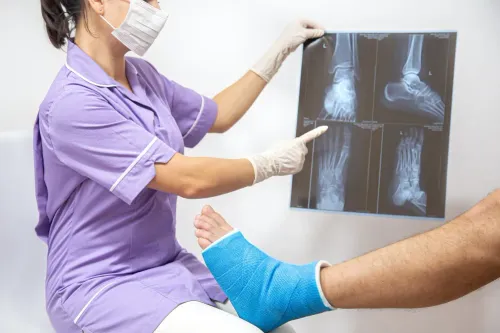
X-rays can help assess the degree and pattern of joint damage.
Does Arthritis Automatically Mean Knee Replacement?
No.
Many people with knee arthritis can initially be managed without surgery. Depending on the patient's condition, management may include:
- Activity modification
- Weight management
- Physiotherapy
- Muscle strengthening
- Appropriate medication
- Walking aids
- Selected injections where clinically suitable
The decision to consider replacement usually depends on the combination of structural damage, persistent symptoms, functional limitations, and response to previous treatment.
What Does Total Knee Replacement Actually Replace?
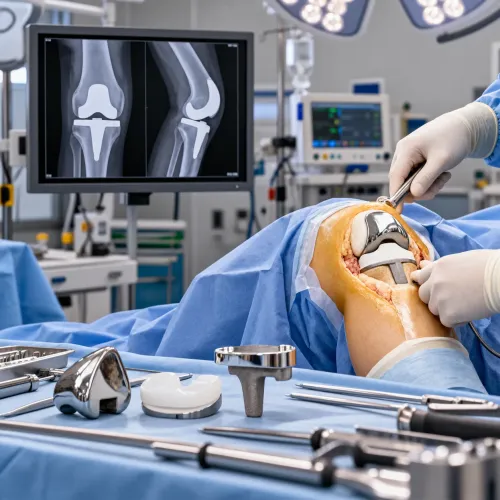
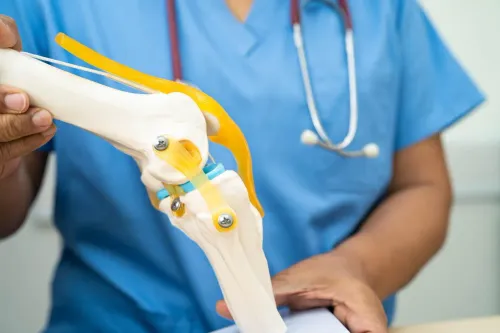
Despite its name, the entire knee is not removed.
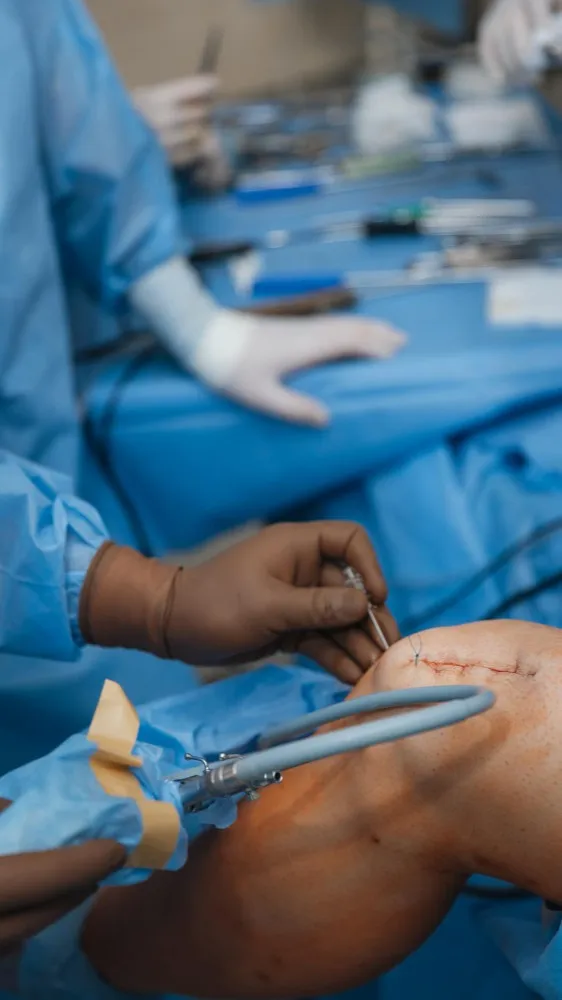
During surgery, damaged surfaces at the ends of the bones are prepared and replaced with artificial components. A specialised bearing surface allows the reconstructed joint to move.
The exact surgical plan varies according to anatomy, deformity, ligament condition, and other clinical considerations.
Who May Be Ready to Discuss Surgery?
There is no single age at which everyone should have knee replacement.
A detailed surgical discussion may be appropriate when:
- Knee pain significantly limits daily activities
- Symptoms continue despite suitable conservative care
- X-rays demonstrate advanced joint degeneration
- Walking distance has substantially decreased
- Deformity is progressing
- Night or rest pain is becoming troublesome
- Quality of daily function is considerably affected
The patient's overall medical fitness also needs to be considered.
What Happens After Surgery?
Recovery requires active participation.
Patients are generally encouraged to begin appropriate movement and rehabilitation according to the surgeon and physiotherapist's instructions. Early exercises focus on circulation, muscle activation, knee movement, and safe mobility.
As recovery progresses, rehabilitation may work on:
- Knee bending and straightening
- Quadriceps strength
- Walking pattern
- Balance
- Stair negotiation
- Functional independence
Recovery differs between patients, so comparisons with another person's timeline are rarely useful.
Preparing for a Knee Replacement Consultation
Bringing previous X-rays, investigation reports, medication lists, and information about existing illnesses can help the consultation.
Patients should explain which activities have become difficult. Saying that the knee 'hurts' provides less information than explaining that pain prevents walking for ten minutes, climbing stairs, sleeping comfortably, or performing work.
Anand Orthopaedic Hospital in Moshi assesses patients with knee arthritis and other degenerative joint conditions to determine whether continued non-operative management or surgical treatment is appropriate.
Knee replacement should be viewed as a clinical decision rather than an automatic next step after an arthritis diagnosis. The important question is whether the condition has reached a stage where symptoms and functional restrictions remain substantial despite appropriate conservative measures.
A thorough assessment allows patients and families to understand the severity of the arthritis, available alternatives, surgical considerations, and rehabilitation requirements before deciding how to proceed.
Keywords