Most fractures gradually unite after appropriate treatment, but healing does not always progress as expected. A fracture may fail to unite within the expected clinical timeframe or may heal in an unsuitable position. In such situations, nonunion and malunion fracture correction may be considered after detailed evaluation.
For patients in Pune who continue to experience pain, deformity, weakness, or difficulty using a limb months after a fracture, specialist orthopaedic assessment can help determine whether the bone has healed appropriately.
What Is a Nonunion?
A nonunion occurs when a fracture fails to show satisfactory progression toward healing.
Patients may experience:
- Persistent pain at the fracture site
- Abnormal movement
- Difficulty bearing weight
- Ongoing functional limitation
- Persistent fracture findings on imaging
The diagnosis requires clinical and radiological evaluation rather than being determined solely by the number of weeks since the injury.
What Is a Malunion?
A malunion occurs when the bone heals but does so in an unsuitable position.
The healed bone may be:
- Angulated
- Rotated
- Shortened
- Misaligned
The significance depends on which bone is affected and how much the deformity influences movement, joint mechanics, appearance, or limb function.
A small deformity may cause little difficulty in one location while a similar degree of malalignment elsewhere can be functionally important.
Why Might a Fracture Fail to Heal?
Bone healing depends on both biology and mechanical stability.
Factors that may contribute to delayed or failed healing include:
- Severe initial injury
- Poor blood supply
- Significant soft-tissue damage
- Infection
- Bone loss
- Inadequate stability
- Certain patient-related health factors
Identifying the cause is important because simply repeating the original treatment may not address the underlying problem.
How Is the Problem Investigated?
Evaluation can include:
- Clinical examination
- Current X-rays
- Comparison with previous imaging
- CT scan in selected cases
- Blood investigations where indicated
- Assessment for possible infection
- Review of previous surgery and implants
The surgeon also assesses limb alignment, joint movement, muscle condition, and functional limitations.
What Can Correction Involve?
Treatment varies considerably.
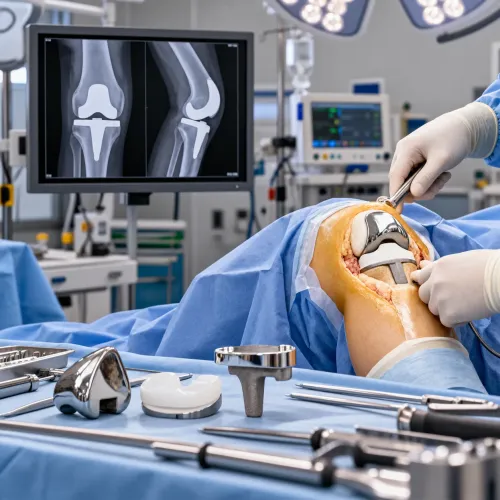
A nonunion may require improving mechanical stability, biological healing conditions, or both. Surgical treatment can involve revision fixation, bone grafting, correction of alignment, or other techniques according to the individual case.
Malunion correction may involve carefully repositioning the bone to restore more appropriate alignment.
Complex cases require detailed preoperative planning because previous implants, scar tissue, bone quality, deformity, and joint condition can influence the procedure.
How Do You Know When Specialist Assessment Is Appropriate?
Patients should consider further orthopaedic evaluation when:
- Fracture-site pain persists unexpectedly
- Progress on follow-up X-rays is limited
- The limb appears visibly deformed after healing
- Walking remains significantly abnormal
- A healed limb feels shortened or rotated
- Previous fixation has failed
- Function remains poor despite rehabilitation
These findings do not automatically mean another operation is necessary, but they justify detailed assessment.
What Should You Bring to the Consultation?
Previous medical records can be particularly valuable in nonunion and malunion cases.
Where available, bring:
- Initial injury X-rays
- Recent X-rays
- CT or MRI reports
- Previous operative notes
- Implant details
- Discharge summaries
- Records of infection or wound problems
- Details of previous rehabilitation
Seeing how the fracture changed over time helps the surgeon understand the healing history.
Anand Orthopaedic Hospital in Pune evaluates complicated fracture-healing problems, including cases where previous treatment has not produced satisfactory union or alignment. The appropriate plan depends on the original injury, current bone condition, previous procedures, and the patient's functional difficulties.
A fracture that has not healed as expected should not simply be regarded as a permanent limitation. Careful investigation can establish whether the problem involves biology, stability, alignment, infection, or a combination of factors and whether corrective treatment is appropriate.
Keywords