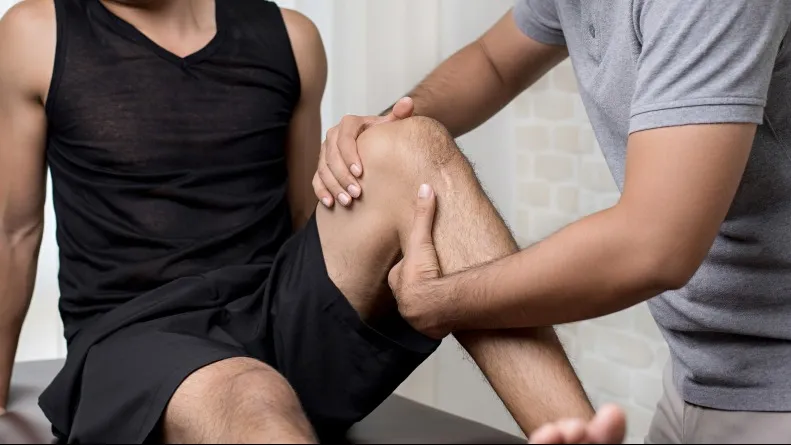
For an athlete, being pain-free is encouraging, but it does not always mean the injured area is ready for competition. Returning too quickly can expose tissues to loads they have not yet regained the capacity to handle. Effective sports injury rehabilitation therefore focuses on restoring movement, strength, control, and sport-specific function rather than simply waiting for pain to disappear.
This is relevant not only to professional athletes but also to runners, gym users, football and cricket players, cyclists, and recreational sports participants across Pune.
Rehabilitation Starts With the Correct Diagnosis
Different sports injuries require different recovery strategies.
Common orthopaedic sports conditions include:
- Ankle sprains
- Muscle strains
- Meniscus injuries
- Ligament injuries
- Shoulder instability
- Tendon problems
- Stress injuries
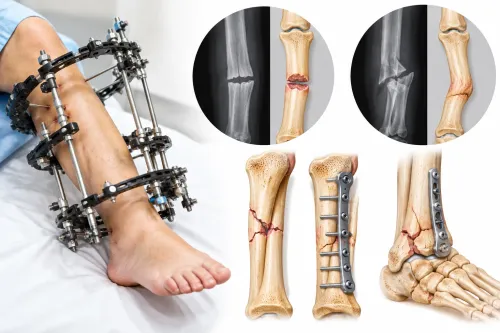
- Sports-related fractures
- Overuse conditions
The first step is determining which structure is injured and how severely it has been affected.
Phase One Focuses on Protecting the Injury
Immediately after an injury, the priority may be controlling symptoms and protecting damaged tissues.
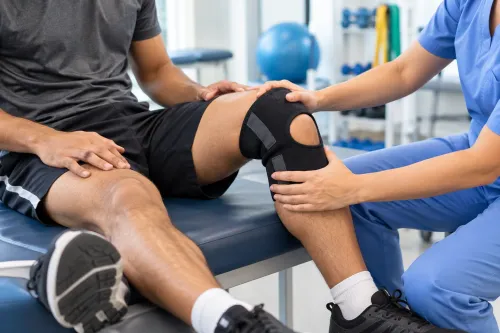
Depending on the condition, treatment can involve activity modification, bracing, medication, or other appropriate measures.
The goal is not to stop movement indefinitely. It is to avoid stressing the injured structure beyond what it can safely tolerate during the early healing phase.
Phase Two Restores Movement
Injuries and periods of protection can reduce joint mobility.
Rehabilitation may progressively work on restoring:
- Joint range
- Soft-tissue mobility
- Normal movement patterns
- Basic muscle activation
The exact exercises depend on the injury.
Forcing movement aggressively is not necessarily better. Progress should reflect tissue healing and clinical assessment.
Phase Three Rebuilds Strength
An injured limb can lose strength quickly.
Rehabilitation therefore progresses from controlled exercises toward increasing resistance and functional movement.
For a knee injury, this may involve the quadriceps, hamstrings, hips, and calf rather than focusing on the painful area alone.
For shoulder injuries, rehabilitation may include the rotator cuff, shoulder blade control, and upper-body movement patterns.
Phase Four Develops Balance and Control
Sports require rapid reactions.
After an ankle or knee injury, for example, an athlete may have adequate muscle strength but still lack balance or neuromuscular control.
Training can therefore include:
- Single-leg stability
- Direction changes
- Landing control
- Coordination drills
- Progressive agility
These abilities become increasingly important as return to sport approaches.
Sport-Specific Testing Comes Later
A runner needs different capabilities from a badminton player or footballer.
Before unrestricted participation, rehabilitation may progressively reproduce the demands of the sport.
This can include:
- Running
- Jumping
- Cutting
- Accelerating
- Decelerating
- Throwing
- Sport-specific drills
The athlete's response to increasing load provides useful information about readiness.
Why Pain Alone Is a Poor Return-to-Sport Test
Pain may decrease before strength and control have fully recovered.
A safer return decision considers several factors, including:
- Movement
- Strength
- Stability
- Functional testing
- Confidence
- Sport-specific ability
- Medical assessment
Returning simply because an important match is approaching can increase risk if rehabilitation is incomplete.
Anand Orthopaedic Hospital in Pune evaluates sports-related bone, joint, ligament, and soft-tissue injuries and can coordinate orthopaedic management with rehabilitation according to the diagnosis.
Good sports rehabilitation is progressive rather than rushed. The goal is to help an athlete move from injury protection to normal movement, then strength, control, and finally the specific physical demands required by their sport.
Keywords